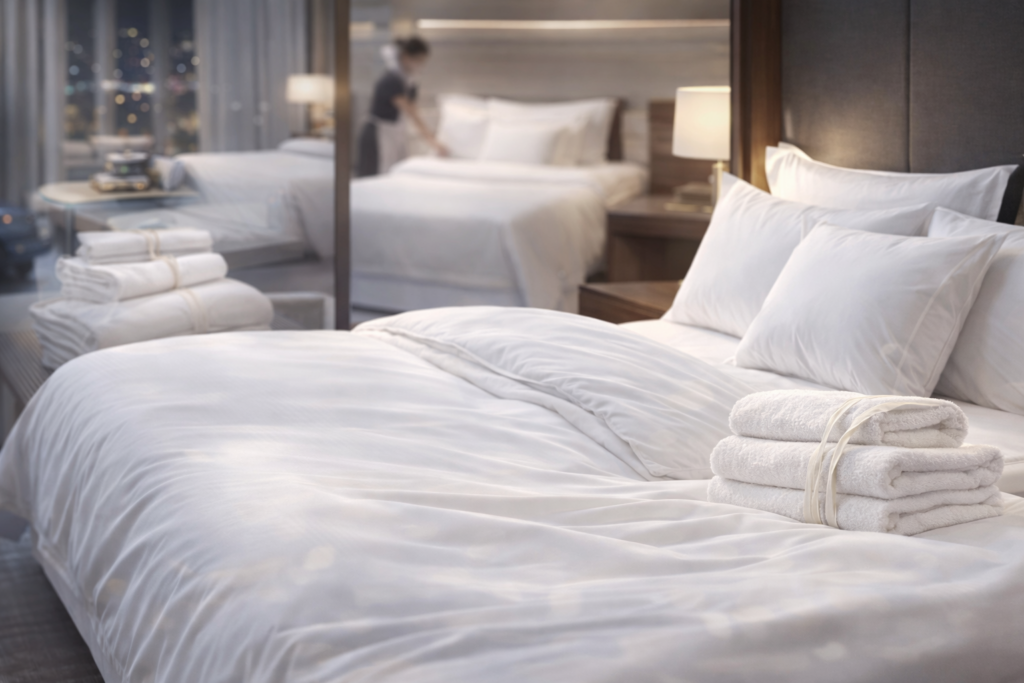
Industrial-Wash-Resistant Hotel Textiles: B2B Purchasing and Cost Guide
One of the hidden factors determining profitability in hotel management is laundry costs and the depreciation period of textile products. Hotel operations differ entirely from domestic use, involving high temperatures, harsh chemicals, and the pressure of industrial ironing equipment. Consequently, purchasing “cheap bulk bed sheets” often results in a massive replacement budget at the end of the year.
So, what should hotel textiles that are truly resistant to industrial washing actually look like from a technical standpoint? In this guide prepared by Nnovatex, we examine the technical data and industry realities that will help you optimize your B2B purchasing decisions.
How Does Industrial Washing Wear Out Hotel Textiles?
The difference between a home washing machine and a hotel laundromat isn’t just capacity. The industrial process attacks fabric fibers from three primary branches:
- Thermal Stress: Continuous washing in the 70°C–90°C range and high-temperature drying.
- Chemical Damage: Chlorinated bleaches and industrial alkaline detergents used to remove stubborn stains.
- Mechanical Tension: In particular, the stretching of the fabric under high pressure by calenders leads to seam bursts and distortions in the fabric’s width-to-length ratio.
These fabrics, capable of withstanding three types of stress, are special series produced based on weaving engineering rather than merely their cotton content.
Do You Have Sourcing Needs? Explore our products—which have undergone industrial durability testing—to reduce your business’s textile replacement costs. [Contact Nnovatex experts today.]
This article may interest you. Why is Choosing the Right Textile Manufacturer Critical?
The 3 Most Common Critical Mistakes B2B Buyers Make
A situation we frequently encounter in the field is hotels comparing prices based solely on GSM (grams per square meter) or a “cotton” label. The most common mistakes made in practice are as follows:
- Focusing Only on the Initial Price: If you buy a bed sheet from Company X for 100 TL and one from Company Y for 130 TL, you might think Company X is the better deal. However, if the product from Company X wears out after 80 washes while the one from Company Y lasts for 200 washes, the cheaper product actually ends up costing you 60% more.
- Failing to Check Shrinkage (Sanforization) Values: The maximum shrinkage tolerance for the fabric after washing should be between 2% and 3%. Fabrics that have not been Sanforized shrink so much upon the first wash that they may no longer fit the bed.
- Choosing the Wrong Fabric for the Concept: 100% cotton is essential for resort hotels. However, for city hotels—where room turnover and laundry traffic are extremely high—insisting on 100% cotton increases drying costs and the rate of wear and tear.
100% Cotton or Polycotton? The Right Decision Matrix
In this case, the option that should be prioritized depends on your hotel’s profile and your laundry budget.
| Criterion | 100% Cotton | 80% Cotton / 20% Polyester (Polycotton) |
| Area of Use | 5-Star Hotels, Luxury Boutique Hotels | Business Hotels, City Hotels, Dormitories |
| Washing Durability | Average (Wears out quickly with optical brighteners) | Very High (Polyester fibers protect the bonds) |
| Drying Time and Energy | Long (Consumes more energy) | Fast (Provides significant energy savings) |
| Iron Grip | It is harder to smooth out wrinkles. | Very fast and smooth results with the rotary iron. |
In our view, the most critical criterion here is increasing operational speed without compromising customer satisfaction. We maintain that, for hotels with high turnover rates, an 80% cotton/20% polyester blend is far more cost-effective in terms of energy savings and durability.
A Common Misconception: The Myth That a High Thread Count Is Always Better
Making a decision based solely on thread count (TC) is the biggest mistake made in this regard.
Common Misconceptions: “If a sheet has a thread count (TC) of 250 or 300, it is definitely more durable than one with a thread count of 145.”
The reality is this: If you weave a 300-thread-count fabric using weak yarn made from short, fine cotton fibers, the fabric may feel soft, but it will begin to tear “like paper” within a few months in an industrial laundry setting. For wash durability, the ideal choice is standard 145 TC (Ranforce) or 200 TC (Akfil/Percale) fabric woven from high-quality, long-staple yarn. What matters is not the thread count, but the tensile strength of the yarn.
Technical Resistance Criteria Against Roller Ironing and Harsh Chemicals
Shrinkage (Sanfor) Standards
Sanforizing (pre-shrinking) is mandatory during the production of hotel textiles designed to withstand industrial washing. Otherwise, the fabric structure locks up upon the first exposure to 90°C temperatures, resulting in dimensional loss in both width and length.
Yarn Quality: Why Choose Ring-Spun Yarn?
In practice, towels and bed linens woven from Open-End (OE) yarn—chosen to keep production costs low—are very common on the market. However, high-quality hotel textiles should invariably use Ring-spun yarn. Ring spinning is a technique in which fibers are twisted more tightly; the resulting yarn is smooth and possesses a much higher breaking strength than OE yarn.
Price vs. Wash Cycle: Hotel Textile Depreciation Analysis
The key metric for professional buyers (Purchasing Managers) should be Cost Per Use.
- Standard Product: 300 TL / 80-wash lifespan = Cost per wash 3.75 TL
- Industrial Durable Product: 400 TL / 200-Wash Lifespan = Cost per wash: 2.00 TL
As can be seen, paying 30% more for a high-quality product that complies with industrial norms will reduce your laundry textile renewal budget by approximately 50% in the long run.
Optimize Your Purchasing Budget: Get a quote now for our high-cycle-life products that will save your business money in the long run.
Checklist for Selecting Long-Lasting Hotel Textiles
Be sure to verify the following details before entering into an agreement with a new supplier:
- [ ] Have the products undergone a sanforization process (guaranteed not to shrink)?
- [ ] Are ring-spun or open-end yarns used in the fabrics and towels?
- [ ] Are the edge seams on the towels double-layered and securely tacked? (Critical for roller iron pressure)
- [ ] Can the manufacturer provide test data regarding optical brighteners and high heat?
- [ ] Are the bed linen sets sized to accommodate the height (thickness) of hotel beds?
Build a Reliable Supply Chain with Nnovatex
In your search for hotel textiles capable of withstanding industrial laundering, we offer products backed by a robust technical infrastructure and a transparent approach that eliminates hidden costs. By collaborating to analyze the yarn, weave, and dimensions best suited to your hotel’s operational intensity, we ensure you maximize the return on your investment.
Secure Your Supply Chain: Don’t leave technical details to chance. Contact Nnovatex experts now for custom production options and sample requests tailored to your business.
Frequently Asked Questions (FAQ)
At what temperature should hotel linens be washed?
Hotel linens are typically washed in industrial laundries at temperatures between 70°C and 90°C using chlorine or oxygen-based bleaches to eliminate heavy soiling and bacteria.
What should be the ideal weight (GSM) for a hotel towel?
Finding the right balance is important when it comes to face and bath towels. A towel that is too thin feels low-quality, while one that is too thick fails to dry properly and wastes energy. As an industry standard, towels with a weight of 450–550 GSM offer the ideal balance between durability and drying performance.
Which fabric weave is the most resistant to industrial washing?
For hotel use, 57-thread count (Ranforce) is the entry-level standard. However, for maximum durability and smooth ironing, 83-thread count (Akfil/Percale) or special-blend poly-cotton fabrics are recommended.